

Over the years, through my work in chaplaincy, leadership development, and wellness education, I began to notice patterns in the challenges leaders and helping professionals face. People are deeply committed to their work, yet often carry emotional weight, complex decisions, and responsibilities that can quietly erode their well-being. In response, I developed a set of practical frameworks to help individuals and organizations think more clearly about leadership, emotional health, and sustainable impact. These models provide structure for conversations that often feel overwhelming—offering language, tools, and pathways for navigating stress, responsibility, grief, and growth. Each framework addresses a different aspect of leadership and wellness. Together, they create a system that helps people process experiences, make thoughtful decisions, and build healthier rhythms for both life and work. The frameworks below represent the foundation of my teaching, writing, workshops, and speaking engagements. Click the framework for more detailed information.

D6 Self Awareness Model

Balance Axis: Planning, Prioritization, Partnership

Individual Wellness Support Plan

WISH
Framework
A-Game
Framework

Lean-In Goal Achievement Model

Healing Arc

Emotional Response Continuum

CLEAR Communication Model

The D6 Self-Awareness Model
Six steps for practicing self-partnership before external partnership.
The D6 Self-Awareness Model is a reflective framework designed to help individuals understand their internal experiences and respond
to life with greater clarity and intention. Before we can lead, care for others, or make wise decisions in complex situations, we
must first learn how to partner with ourselves.
Many challenges in leadership, relationships, and personal well-being arise not only from circumstances but also from how our experiences, emotions, values, and assumptions shape our responses. The D6 model offers a structured process for slowing down, examining those influences, and moving forward with greater awareness.
The six steps guide individuals through a journey of reflection and action:
-
Dig In – exploring what lies beneath the surface of our thoughts, emotions, and recent actions.
-
Dissect – examining the influences and experiences shaping the current situation.
-
Discern – clarifying truth, responsibility, and our internal commitment moving forward.
-
Discard – releasing what is not ours to carry.
-
Direction – charting a course and taking intentional steps forward.
-
Discovery – uncovering insight, wisdom, and unexpected value within the experience.
While the steps appear sequential, the process is often cyclical. Each discovery deepens self-awareness and prepares us to engage the next challenge with greater clarity and resilience.
At its core, the D6 Self-Awareness Model invites individuals to practice self-partnership—developing the insight and internal alignment necessary to lead, serve, and live well.

The Balance Axis™ Framework
The Balance Axis™ Framework explores the relationship between three essential elements of sustainable leadership and healthy living: Planning, Prioritization, and Partnership.
When these three elements work together, leaders experience alignment—a sense that their responsibilities, resources, and direction are working in harmony. However, when one of these elements is missing or underdeveloped, predictable forms of strain emerge.
Planning
Intentional direction, structure, and foresight.
Planning provides the roadmap that guides action and helps leaders anticipate challenges before they arise.
Prioritization
Clarity about what matters most.
Prioritization ensures that energy, attention, and resources are focused on the most meaningful and necessary work.
Partnership
Shared responsibility and support.
Partnership reminds us that sustainable leadership is rarely achieved alone. Collaboration, delegation, and trusted relationships create resilience and longevity.
Understanding the Areas of Imbalance
The Balance Axis also reveals what happens when one element is missing.
Planning + Partnership without Prioritization → Instability
When people collaborate and make plans but lack clarity about what matters most, energy becomes scattered and progress feels inconsistent.
Planning + Prioritization without Partnership → Depletion
When leaders carry vision and clarity alone without shared responsibility, exhaustion often follows.
Prioritization + Partnership without Planning → Misalignment
When people share priorities and support one another but lack intentional direction and structure, efforts can drift without producing meaningful results.
Sustainable leadership emerges when Planning, Prioritization, and Partnership work together in alignment.
A Framework for Clarity and Action
The Balance Axis™ Framework provides a way for leaders and organizations to evaluate where their systems are strong, where strain is developing, and how to restore alignment. It is often used in leadership development, organizational reflection, coaching conversations, and personal wellness planning to help individuals move from overwhelm toward intentional and sustainable leadership.

The Individual Wellness Support Plan (IWSP)
The Individual Wellness Support Plan (IWSP) is a structured framework designed to help individuals intentionally care for their emotional, mental, spiritual, and relational well-being.
Rather than approaching wellness as something addressed only after stress or burnout occurs, the IWSP encourages proactive preparation. It helps individuals identify the practices, supports, and strategies that sustain their well-being before challenges arise.
The framework also recognizes an important reality: seasons of strain, crisis, and recovery are normal parts of life and leadership. By planning for these realities in advance, individuals and organizations can respond to difficult moments with clarity, support, and stability rather than confusion or isolation.
The IWSP includes ten key components that help individuals build a comprehensive support structure for their well-being:
-
Wellness Toolbox – Personal practices that support emotional, spiritual, and mental well-being.
-
Personal Wellness Check – Regular self-reflection that helps individuals recognize shifts in emotional or mental health.
-
Daily Practice Plan – Intentional rhythms and habits that sustain stability and balance.
-
Support Systems – Trusted people who provide encouragement, accountability, and care.
-
Self-Care Routine – Restorative practices that replenish energy and reduce stress.
-
Triggers – Situations or experiences that may increase emotional strain or stress.
-
Coping Strategies – Healthy responses that help individuals navigate challenges in constructive ways.
-
Early Warning Signs – Indicators that stress or overwhelm may be increasing, and additional support may be needed.
-
Signs of Distress & Crisis Plan – A pre-identified plan that outlines what steps should be taken if serious distress emerges, including whom to contact and what resources are available.
-
Post-Crisis Recovery – A recovery plan developed in advance that normalizes the need for rest, support, and reintegration after difficult seasons.
Together, these components help individuals transition from reactive self-care to intentional, sustainable wellness.
The IWSP is often used by leaders, caregivers, educators, and helping professionals who want to care for others without neglecting their own well-being. When combined with frameworks such as the Balance Axis™, the IWSP provides a practical structure for sustaining both leadership and personal health over time.

The W.I.S.H. Framework
Willingness • Invest • Structure • Healing
The W.I.S.H. Framework is a model for personal growth and restoration that recognizes that meaningful change does not happen accidentally—it happens intentionally.
Whether individuals are navigating personal challenges, professional strain, emotional fatigue, or seasons of transition, healing and growth require more than hope alone. They require willingness, commitment, supportive structure, and space for restoration.
The W.I.S.H. Framework outlines four essential elements that help individuals move toward sustainable wellbeing.
Willingness: Openness to growth and change.
Transformation begins with willingness. Before new habits, healing, or progress can take place, individuals must first be open to examining their experiences and considering the possibility of change.
Invest: Choosing to invest time, energy, and attention.
Growth requires investment. Change occurs when individuals intentionally devote the necessary time, energy, and focus toward the practices and relationships that support their well-being.
Structure: Creating rhythms, boundaries, and systems.
Sustainable change rarely happens without structure. Healthy rhythms, clear boundaries, and supportive systems create stability and help individuals maintain progress even during challenging seasons.
Healing: Restoration, renewal, and integration.
Healing is not simply the absence of difficulty—it is the process of restoration and integration. Through reflection, support, and intentional care, individuals can renew their strength and carry forward the wisdom gained through their experiences.
A Framework for Growth and Renewal
The W.I.S.H. Framework reminds us that while we may hope for change, real transformation requires both intention and structure. By cultivating willingness, investing in growth, building supportive systems, and allowing space for healing, individuals can move toward lives marked by resilience, clarity, and renewed purpose.
The A.GAME Framework
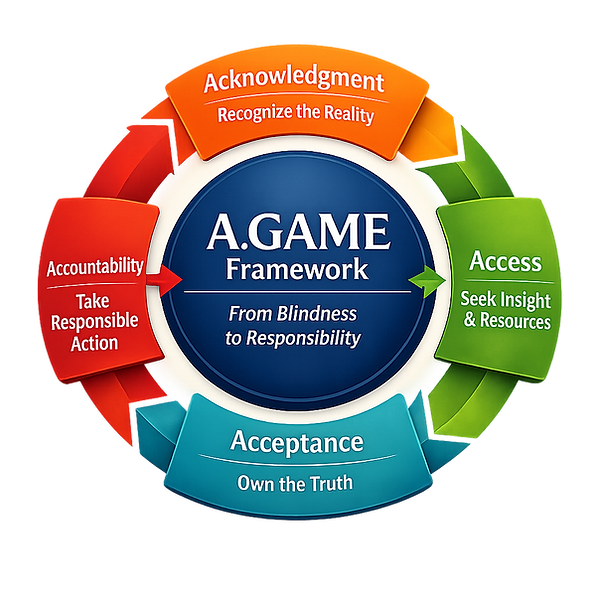
A pathway from blindness to responsibility.
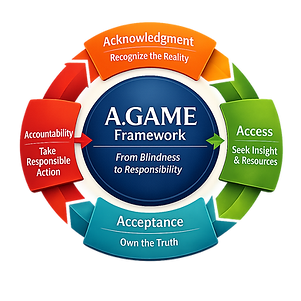
The A.GAME Framework is designed to help individuals move from confusion, avoidance, or denial toward clarity, responsibility, and constructive action.
In many situations, people know that something is wrong but struggle to move forward. A leader may sense tension within a team but hesitate to address it. A professional may recognize that burnout is developing but continue pushing forward without adjusting their workload. An organization may see signs that a system is failing yet delay difficult conversations about change.
In these moments, progress often stalls not because solutions are unavailable, but because reality has not yet been fully acknowledged or owned.
The A.GAME Framework provides a structured process for moving through that barrier. It guides individuals from recognizing the truth of a situation to taking responsible action that leads to growth, resolution, or change.
The framework moves through four key stages:
Acknowledgment: Recognize the reality.
The process begins with acknowledging what is true. Before meaningful change can occur, individuals must first recognize the circumstances, behaviors, or challenges they are facing without minimizing or avoiding them.
Access: Seek insight and resources.
Once reality is acknowledged, the next step is gaining access to understanding and support. This may include seeking knowledge, professional guidance, trusted counsel, or additional resources that help illuminate the situation more clearly.
Acceptance: Own the truth.
Acceptance involves embracing responsibility for what is within one’s control. Rather than remaining stuck in blame, denial, or frustration, individuals begin to take ownership of their role and the choices available to them moving forward.
Accountability: Take responsible action.
The final step moves from understanding to action. Accountability means taking the necessary steps to respond responsibly, make adjustments, and follow through on the commitments required for growth or change.
From Awareness to Responsible Action
The A.GAME Framework helps individuals move beyond passive awareness into responsible engagement with the realities they face. By acknowledging truth, accessing insight, accepting responsibility, and acting with accountability, individuals can transform moments of difficulty into opportunities for growth and clarity.

The Lean-In Goal Achievement Model
A structured pathway from intention to meaningful progress.
The Lean-In Goal Achievement Model illustrates how goals move from aspiration to achievement. While many people begin with clear goals and good intentions, progress often stalls when the ongoing work required to reach those goals becomes difficult.
This model uses the image of a ladder to represent the journey of goal achievement. Each rung represents a different stage in the process, reminding us that meaningful progress happens step by step.
Importantly, the ladder also communicates an important truth: the real work does not happen at the top of the ladder. The highest rung represents the outcome we are moving toward, but the effort that carries us there happens in the steps leading up to it.
There are five stages in the Lean-In Goal Achievement Model:
Goal: Where you want to go.
Every pursuit begins with clarity about the destination. Identifying the goal provides direction and purpose for the work ahead.
Plan: Create the process.
Planning establishes the structure that allows progress to occur. A clear plan outlines the steps, resources, and strategies that will guide movement toward the goal.
Lean In: Commit to the process.
The Lean In step is intentionally the largest rung in the model because it represents the longest portion of the journey. Most goals are not achieved through brief effort but through sustained engagement with the process. Leaning in means committing to the work, staying present in the effort, and continuing forward even when the path becomes challenging.
Execute: Do the work with perseverance.
Execution represents the active work of pursuing the goal. In the visual model, this step is connected to the target to emphasize that execution is the stage where effort becomes directly aligned with the desired outcome. It is where plans are translated into consistent action.
Soft Check: Measure progress and adjust the approach.
The Soft Check stage encourages reflection without discouragement. Rather than serving as a harsh evaluation of success or failure, the soft check measures progress toward the goal and allows adjustments to be made along the way. The purpose of this stage is not to disrupt the process, but to strengthen it by learning from experience and refining the approach.
Progress Happens One Step at a Time
The Lean-In Goal Achievement Model reminds us that meaningful accomplishments are rarely achieved through a single moment of effort. Instead, they emerge through clarity of direction, thoughtful planning, sustained commitment, consistent execution, and ongoing reflection.
By leaning into the process and making adjustments along the way, individuals can continue climbing toward the goals that matter most.

The Healing Arc™
A compassionate model for understanding how people move through grief and loss
The Healing Arc™ is a compassion-centered framework that maps how individuals often move through the layered experience of grief. While many people associate grief primarily with death, the Healing Arc recognizes that loss can take many forms—health changes, relationship shifts, identity transitions, career disruptions, and other life-altering experiences.
Inspired by the pioneering work of Elisabeth Kübler-Ross and other grief theorists, the Healing Arc expands the conversation beyond emotional “stages.” Rather than focusing only on feelings, it also reflects the behaviors, beliefs, and coping patterns that often accompany loss.
The arc begins with Avoidance and Numbing, acknowledging the ways people instinctively protect themselves from overwhelming pain. It then moves through Surviving, Acknowledging, and Processing, where individuals begin to confront the reality of their loss and navigate the complex emotional terrain that follows.
As healing progresses, the arc shifts toward restoration. Reconnecting and Rebuilding reflect the gradual return to relationships, routines, and purpose. Over time, many individuals begin to experience Meaning-Making and Integrating, where the loss becomes part of their story—not erased, but woven into a deeper understanding of life, resilience, and identity.
The Healing Arc does not represent a rigid sequence. People may move forward, circle back, pause in one place, or experience multiple phases at once. Rather than prescribing how grief should unfold, the model offers a compassionate lens for recognizing where someone might be in their healing journey.
Ultimately, the Healing Arc reminds us that healing is not about “getting over” loss. It is about learning to live with it in ways that restore wholeness, connection, and hope.
Points Along the Healing Arc
-
Avoidance: A protective response where individuals distance themselves from painful realities or conversations related to the loss.
-
Numbing: Emotional shutdown or distraction used to dull overwhelming feelings and create a temporary distance from grief.
-
Surviving: A period of functioning day-to-day while carrying emotional weight; life continues, but often with limited emotional capacity.
-
Acknowledging: The moment when the reality of the loss begins to be faced and named.
-
Processing: Engaging the grief more directly—feeling, reflecting, talking, journaling, praying, or seeking support.
-
Reconnecting: Gradually re-engaging with relationships, community, and life activities that may have been withdrawn from.
-
Rebuilding: Developing new rhythms, routines, roles, or identities in the wake of loss.
-
Meaning Making: Discovering insight, wisdom, or spiritual understanding that emerges through the experience of grief.
-
Integrating: The loss becomes part of one’s life story—not forgotten, but held with greater peace, resilience, and perspective.
How the Arc Works
The left side of the arc reflects protective responses that help people endure overwhelming emotional pain. The center of the arc represents the active work of grief. The right side reflects restoration and integration, where individuals begin rebuilding life while still honoring the loss.
Healing rarely follows a straight line. The Healing Arc simply offers a compassionate way to understand the movement of healing over time.

Emotional Response Continuum™ (ERC)
A simple framework for recognizing and discussing emotional well-being
The Emotional Response Continuum™ (ERC) helps individuals understand the range of emotional states people move through in everyday life. Rather than viewing emotions as isolated experiences, the continuum illustrates how our internal state can shift along a spectrum—from thriving and energized to overwhelmed and distressed.
The model includes five broad emotional zones:
-
Soaring – A state of high energy, joy, and confidence where individuals feel empowered, capable, and fully engaged with life.
-
Succeeding – A positive and stable emotional state marked by motivation, contentment, and a sense of progress or accomplishment.
-
Surviving – The emotional middle ground where individuals are functioning and managing responsibilities, but may feel cautious, tense, or simply focused on getting through the day.
-
Struggling – A state where stress, uncertainty, and emotional fatigue begin to take a greater toll on focus, resilience, and decision-making.
-
Suffering – A deeper level of emotional distress characterized by feelings of grief, despair, helplessness, or emotional depletion.
The ERC is designed not only for personal reflection but also for group check-ins, particularly in high-impact professions such as healthcare, education, ministry, social work, and leadership. Teams can use the continuum as a simple language for sharing where they are emotionally in a given moment.
During these check-ins, individuals may name where they currently find themselves on the continuum and reflect on questions such as:
-
What support would help me move toward a healthier place?
-
What do I need right now to remain stable where I am?
-
What resources or practices might help our team care for one another more effectively?
In this way, the Emotional Response Continuum creates a non-judgmental structure for emotional awareness, communication, and mutual support within teams that regularly carry significant emotional responsibility.
Within Dr. Peggi Trusty’s broader wellness framework, the ERC helps individuals identify their current emotional position, while models such as the Healing Arc™, D6 Self-Awareness Model, Balance Axis™, and Individual Wellness Support Plan (IWSP) provide tools for reflection, recovery, and sustainable well-being.

CLEAR Communication Model™
Enhancing Receptive Leadership
Effective leadership communication is not determined solely by what is said, but by how well the message is received. Leaders often assume that if an idea is expressed clearly, it will automatically be understood. In reality, people receive and process communication in different ways.
The CLEAR Communication Model™ helps leaders increase receptivity by expressing important ideas through multiple communication channels. When leaders communicate clearly across these channels, teams are more likely to understand expectations, engage with the work, and respond effectively.
CLEAR represents five complementary ways leaders can communicate ideas so they are more easily received and processed.
C — Connect
Build trust and relational safety so people are open to the message. Connection creates the environment where communication can be received rather than resisted.
L — Language
Explain the idea clearly through conversation, dialogue, and verbal clarification. Language helps people hear the meaning and intent behind the message.
E — Experience
Demonstrate or practice the idea so others can engage with it directly. Experiential communication helps translate concepts into real-world action.
A — Appearance
Show the structure of the idea visually through diagrams, frameworks, or written outlines. Visual communication helps people see the organization and logic behind the message.
R — Reflect
Allow time and space for people to process what they have heard. Reflection helps individuals internalize the message and consider how it applies to their work.
When leaders communicate through these five channels—Connect, Language, Experience, Appearance, and Reflect—they increase clarity, strengthen understanding, and improve collaboration.
The CLEAR Communication Model™ complements the Partnership pillar of the Balance Axis™, reinforcing the idea that effective leadership is not only about making decisions, but about ensuring those decisions are clearly understood and meaningfully received.
Bring These Frameworks
to Your Organization
Frameworks turn insight into action.
Through keynotes, workshops, team experiences, and consulting, Dr. Peggi Trusty helps organizations apply practical models for wellness, leadership, decision-making, and sustainable work.
She also collaborates with leaders and organizations to develop custom frameworks—structured ways of communicating complex ideas so that people can understand them, apply them, and live them out in real environments.
Because clarity is powerful.
And well-designed frameworks help people move.
Interested in bringing this work to your organization?